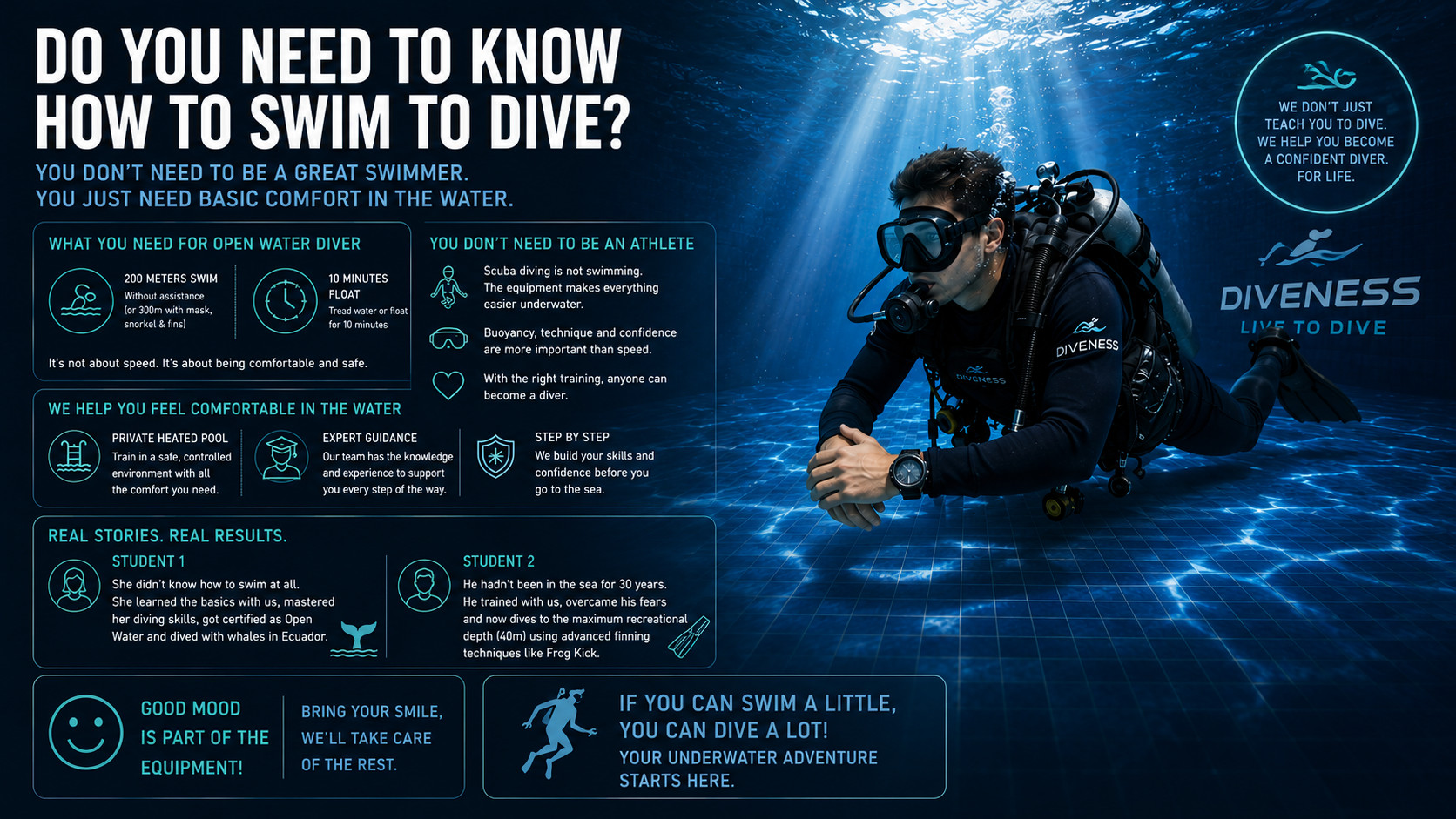


This is probably the most common question we hear from people who are thinking about trying scuba diving for the first time.
And it is usually followed by a clarification:
“I can float, but I’m not a good swimmer.”
or
“I go into the sea, but I’ve never done any serious swimming.”
The short answer is yes, you need to be reasonably comfortable in the water to become a certified scuba diver. However, no, you do not need to be a competitive swimmer, swim fast laps, or have an athletic level of swimming ability.
In fact, many divers who today explore shipwrecks, dive to depths of 30 meters (100 feet), or travel around the world for diving adventures were never particularly strong swimmers when they started.
The most important factor is not speed or swimming technique.
It is comfort and confidence in the water.
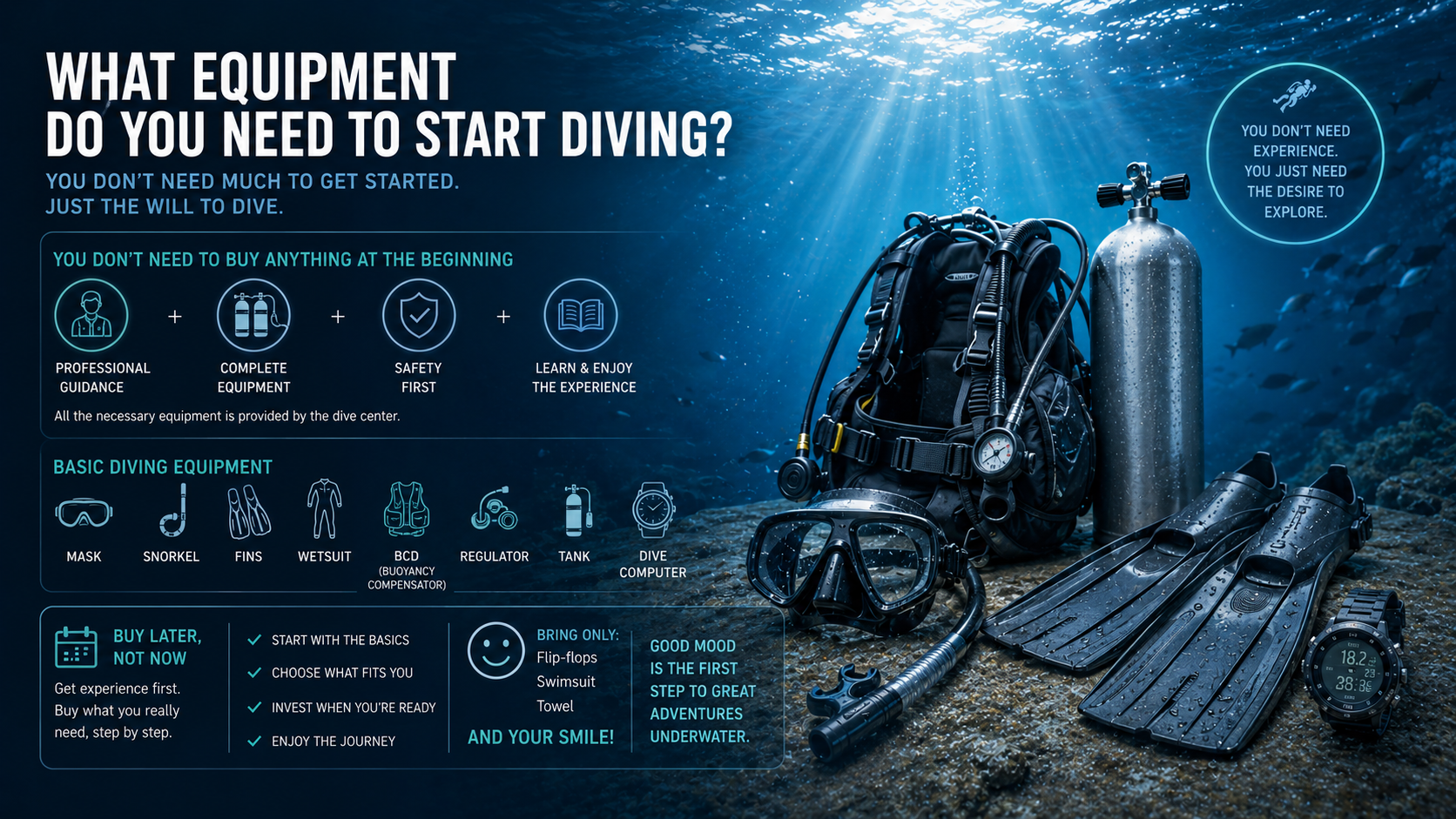
At DIVENESS, what we tell new divers is that the only things you need to bring are your flip-flops, swimsuit, towel, and your smile. We take care of everything else. And between us, the smile is probably the most important of all, because proper training always starts with a positive attitude.
Scuba diving is not swimming.
When you dive, you use equipment that helps you move through the water with minimal effort. Fins, buoyancy, and proper technique make movement much easier than most people who have never tried diving imagine.
Nevertheless, a diver must be comfortable in the water and able to handle simple situations at the surface.
For this reason, training organizations include basic swimming assessments in their certification programs.
To earn your Open Water Diver certification, you do not need to achieve a specific time or athletic performance.
Typically, the requirements include:
Speed is not evaluated.
There is no stopwatch.
You do not “pass” or “fail” because you are not a fast swimmer.
The goal is simply to confirm that you feel comfortable and safe in the aquatic environment.
That depends on how comfortable you feel in the water.
Many people believe they do not swim well enough, but in reality, they can easily meet the requirements of an entry-level scuba diving course.
However, if you are afraid of the water, struggle to float, or avoid deep water, it may be worthwhile to spend some time becoming more comfortable in the aquatic environment before starting scuba training.
And that is not a disadvantage.
It is simply an extra step that will help you feel more comfortable and safer.
At DIVENESS, we have a significant advantage that allows us to help people with very different levels of water experience. Our privately owned heated swimming pool provides a controlled environment, free from waves, currents, and pressure, where every new diver can develop their skills comfortably, calmly, and safely before moving to the sea.
For many people, this is the step that makes all the difference.
One of the biggest mistakes people make is believing that they either “have it” in the water or they do not.
The reality is different.
Comfort in the water is a skill that can be developed.
That is why, at DIVENESS, we do not view people based on where they start, but on where they can go.
A great example is one of our students who, when she first came to us, essentially did not know how to swim. She started with the fundamentals of water confidence, learned how to use scuba equipment correctly, gradually developed self-confidence, and successfully completed her Open Water Diver certification.
A short time later, she traveled to the Galápagos Islands in Ecuador, where she completed dives with whales. An experience that once seemed unimaginable became a reality, one step at a time.
Similarly, another student had not entered the sea for almost thirty years.
His fear of water was real and deeply rooted.
Through systematic training, patience, and proper guidance, he not only overcame his fears but also developed into a highly capable diver. Today, he dives to the maximum recommended recreational diving depth of 40 meters (130 feet) and uses advanced finning techniques such as the Frog Kick, a skill typically seen among more experienced divers.
These stories are not exceptions.
They are proof that progress in the water depends less on where you start and more on how you are trained.
Another reason we are able to effectively support people with limited water experience is Angeliki’s role within our instructional team.
Angeliki is a graduate of the School of Physical Education and Sport Science of the National and Kapodistrian University of Athens and has the scientific background necessary to help individuals develop a structured and healthy relationship with the water.
This means that when a prospective diver needs additional water confidence before moving on to scuba diving, we have both the facilities and the expertise to support them safely and methodically.
For us, the goal is not simply to complete a certification.
The goal is to create a diver who genuinely feels comfortable in the water.
One of the things that surprises almost every new diver is that underwater you do not have to “fight” the water the way you often do while swimming.
Proper buoyancy allows you to hover effortlessly.
Fins multiply your movement.
The equipment supports you.
And very quickly, you discover that scuba diving is more about relaxation and exploration than it is about intense athletic activity.
In fact, one of the first skills a new diver learns is proper buoyancy control. If you would like to understand why it is considered so important, you can also read our article, “Perfect Buoyancy in Scuba Diving – Guide and Tips.”
No, you do not need to be a good swimmer to start scuba diving.
However, you do need a basic level of comfort in the water and the ability to meet the simple requirements of a training program.
If you can swim comfortably, float, and feel safe in the sea, then you probably already have everything you need to take your first step into the world of scuba diving.
And if you feel that you need a little more time or guidance, that does not mean scuba diving is not for you.
It simply means that you will follow your own path to get there.
And very often, those paths lead to the most extraordinary journeys.



 Την Πέμπτη 02/07/26 @ 19:30 πάμε για
 Στα συν της νύχτας :
 Κόστος συμμετοχής 30€ και περιλαμβάνει :
 Δεν περιλαμβάνει nitrox (3€ για όποιον θέλει )
 Για να συμμετέχεις δήλωσέ το ΑΠΑΡΑΙΤΗΤΑ στη φόρμα που ακολουθεί:
  ΚΑΛΗ ΜΑΣ ΝΥΧΤΕΡΙΝΑΡΑ


 Το Diveness επέλεξε το ΚΑΛΥΤΕΡΟ και ΜΕΓΑΛΥΤΕΡΟ ναυάγιο για τα Ελληνικά δεδομένα ,για να αποκτήσει ΑΚΟΜΗ μεγαλύτερη αξία αυτή η ιδιαίτερα συναρπαστική ειδικότητα της PADI, αλλά και ένα μεγάλο γνώστη και εξερευνητή πολλών ναυαγίων, που θα βρίσκεται μαζί μας καθόλη τη διάρκεια της διεκπεραίωσης της ειδικότητας και θα μας πλαισιώσει με τις επιπλέον γνώσεις του επι του αντικειμένου!