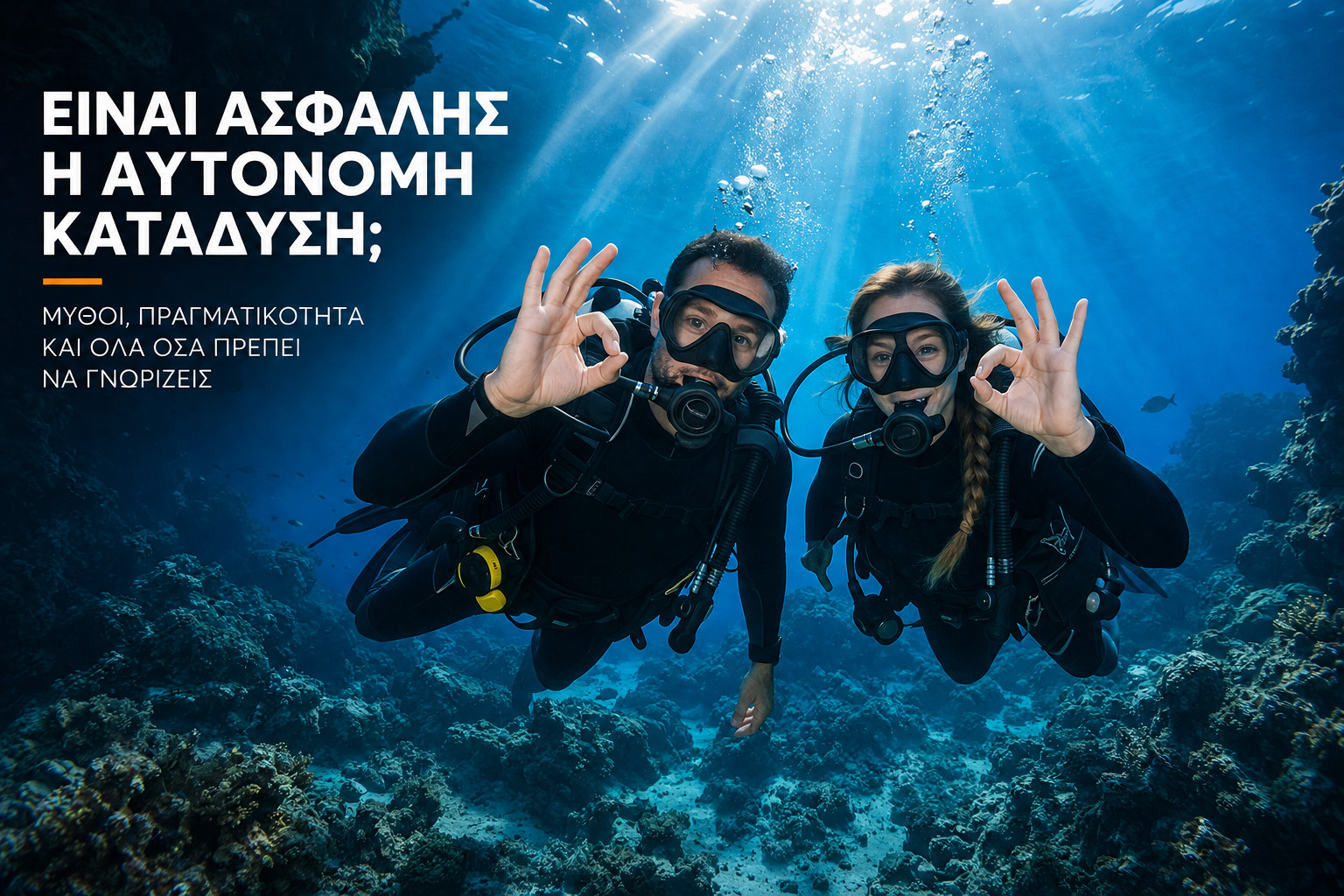


One of the most common questions people ask before trying scuba diving is simple:
“Is scuba diving actually safe?”
It’s a perfectly reasonable concern. After all, breathing underwater is not something humans are naturally designed to do. At first glance, scuba diving may seem intimidating, especially to someone with no previous experience.
The truth, however, is quite different.
When you receive proper training, use well-maintained equipment, and dive within your certification limits, scuba diving is considered one of the safest adventure sports in the world.
Like every outdoor activity, it carries risks—but those risks are greatly reduced through education, preparation, and responsible decision-making.
Let’s explore what truly makes scuba diving safe.
Many people believe scuba diving is about courage.
In reality, it’s about knowledge.
The underwater environment follows clear physical laws. Once you understand how they work, everything begins to make sense.
I still remember something my own instructor, Louis Sklavos, PADI Course Director and one of the pioneers of PADI in Greece, told us during my Instructor Development Course.
He smiled and said:
“Scuba diving is built on three laws and one principle.”
That sentence has stayed with me throughout my entire diving career.
The three gas laws and one physical principle form the foundation of every safe dive:
As depth increases, pressure increases and the volume of gas decreases.
This explains why divers never hold their breath during ascent and why equalization is essential throughout every dive.
Every gas in a breathing mixture contributes to the total pressure.
Understanding this law allows divers to safely use different breathing gases, including Enriched Air Nitrox, while respecting depth limits and oxygen exposure.
As pressure increases, more nitrogen dissolves into the body’s tissues.
During ascent, this dissolved nitrogen must be released gradually. This is why ascent rates, safety stops and dive planning are so important.
Every object immersed in water experiences an upward buoyant force.
This is the principle behind buoyancy control—one of the most important diving skills. Mastering buoyancy not only makes diving easier and more enjoyable but also protects marine life by preventing accidental contact with the underwater environment.
These principles may sound scientific, but they are taught step by step during every quality scuba diving course. Once you understand them, they become second nature every time you enter the water.
Contrary to popular belief, the ocean itself is rarely the problem.
The greatest risk in scuba diving is inadequate training, poor decision-making, or ignoring established safety procedures.
This is exactly why organizations like PADI have developed structured educational programs that gradually build a diver’s knowledge and confidence.
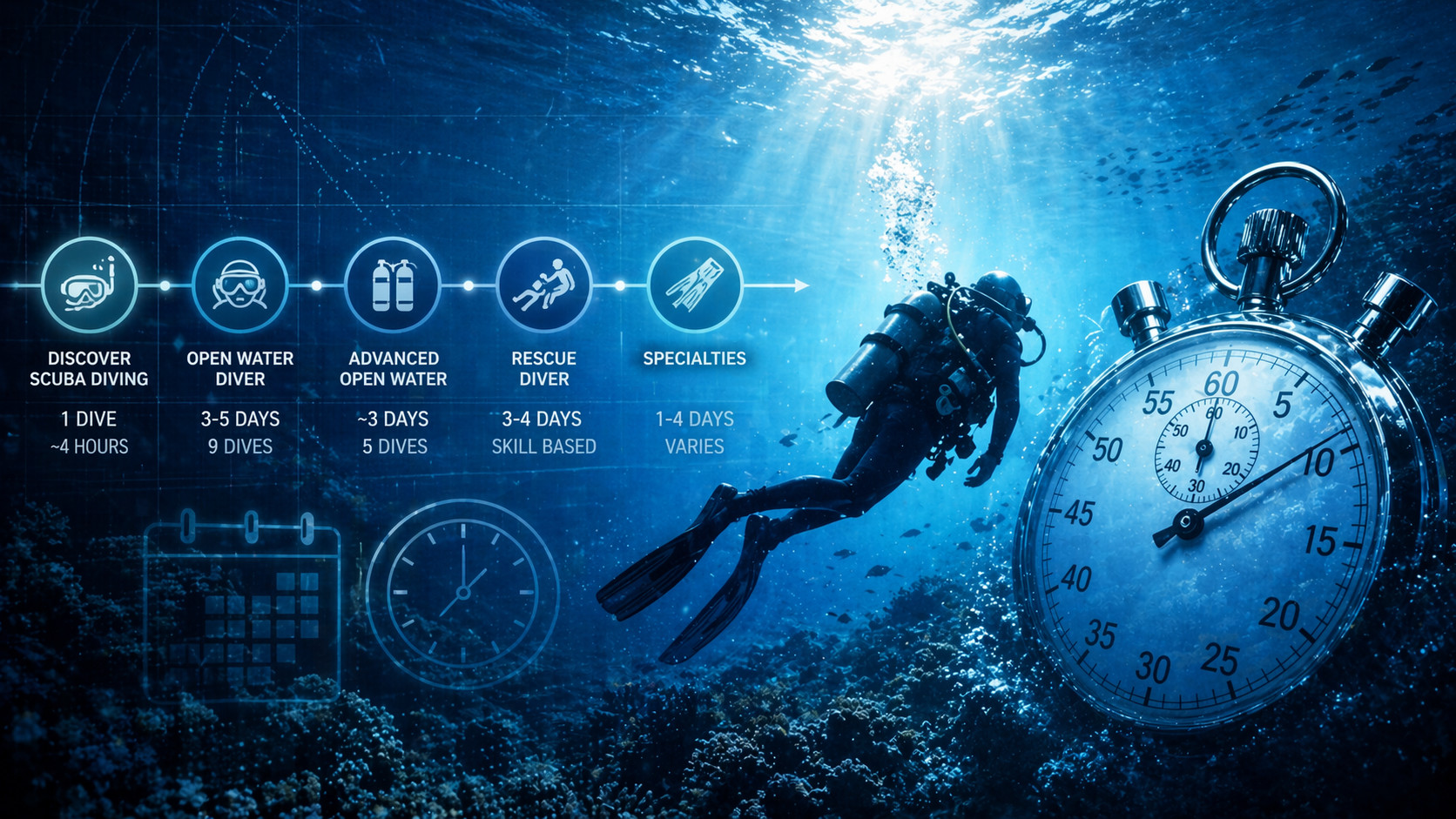
This is where every diver begins.
The Open Water Diver course teaches the essential diving skills, safety procedures, buoyancy control, equipment handling, underwater communication and problem-solving techniques needed to dive safely and independently with a buddy.
Everything else in recreational diving is built upon this foundation.
Despite its name, this course is designed to expand experience rather than dramatically increase difficulty.
Divers complete five Adventure Dives, including Deep Diving and Underwater Navigation, while selecting additional specialties based on their personal interests.
The course allows divers to experience different underwater environments under the direct supervision of a professional instructor.
Many experienced instructors consider this the most valuable recreational diving course.
Rather than focusing only on yourself, you learn to recognize stress in other divers, prevent incidents before they happen, and respond effectively during emergencies.
Above all, Rescue Diver develops awareness, confidence, teamwork and responsibility—qualities that make every diver safer.
The goal of scuba education isn’t simply to earn a certification card.
It’s to develop the judgment needed to make calm, informed decisions underwater.
Every dive presents different conditions.
Visibility changes.
Currents change.
Equipment can occasionally malfunction.
Marine life behaves differently every day.
Proper training gives divers the confidence to recognize situations early and respond before they become problems.
At DIVENESS, we also place significant emphasis on precision underwater movement through our PADI Frog Kick Diver Specialty.
Unlike basic flutter kicking, the Frog Kick technique allows divers to move efficiently in every direction while minimizing disturbance to the environment. It improves buoyancy control, reduces air consumption, prevents accidental contact with fragile marine life, and provides exceptional control when diving around reefs, caves or wrecks.
Like every advanced skill in diving, it isn’t about looking impressive—it is about becoming safer, more efficient and more environmentally responsible.
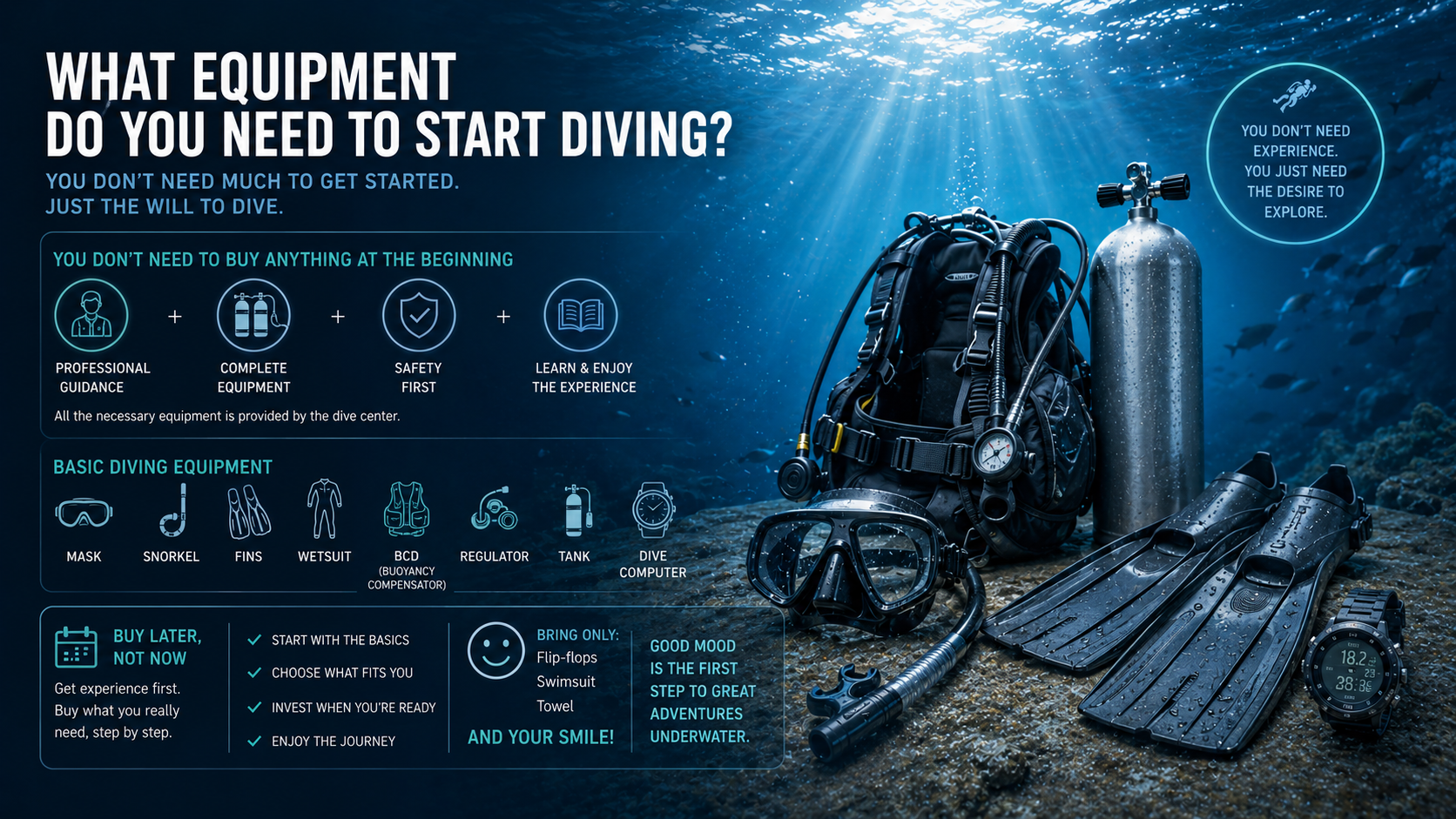
Many beginners see scuba equipment as a collection of tools that simply allows them to breathe underwater.
In reality, every piece of scuba equipment is part of a complete life-support system.
Your regulator delivers breathable gas exactly when you need it.
Your BCD (Buoyancy Control Device) allows you to achieve neutral buoyancy and maintain precise control throughout the dive.
Your dive computer continuously monitors your depth, bottom time and ascent profile, helping you stay within safe limits.
Even something as simple as a mask plays a critical role in underwater comfort and safety.
However, even the best equipment requires proper care.
After every dive, scuba gear should be thoroughly rinsed with fresh water to remove salt, sand and other contaminants that accelerate wear.
Just as importantly, diving equipment must undergo regular manufacturer-recommended servicing.
Regulators, cylinders, valves and other critical components should always be inspected and serviced by authorized service technicians, using original parts and following manufacturer specifications.
Attempting to repair life-support equipment without proper certification is never worth the risk.
Well-maintained equipment doesn’t simply last longer.
It performs exactly as designed when you need it most.
One of the most important principles in recreational scuba diving is the buddy system.
Every diver has a buddy.
This isn’t simply a tradition.
It’s one of the most effective safety systems ever developed.
Your buddy helps you perform pre-dive safety checks.
Your buddy confirms your equipment is correctly assembled.
Your buddy monitors you throughout the dive.
And if an unexpected situation occurs, your buddy is immediately there to assist.
At DIVENESS, we often tell our students something very simple:
“If everyone takes care of their buddy, everyone comes home safely.”
This philosophy extends beyond pairs of divers.
Whenever a group enters the water together, everyone’s safety becomes a shared responsibility.
If one diver encounters a problem, the entire team is affected.
That’s why experienced divers constantly observe one another, communicate clearly, and remain aware of the group’s overall condition—not only their own.
Strong teams create safe dives.
Many people think fear is the opposite of confidence.
In scuba diving, that’s rarely true.
Fear usually comes from uncertainty.
Confidence comes from preparation.
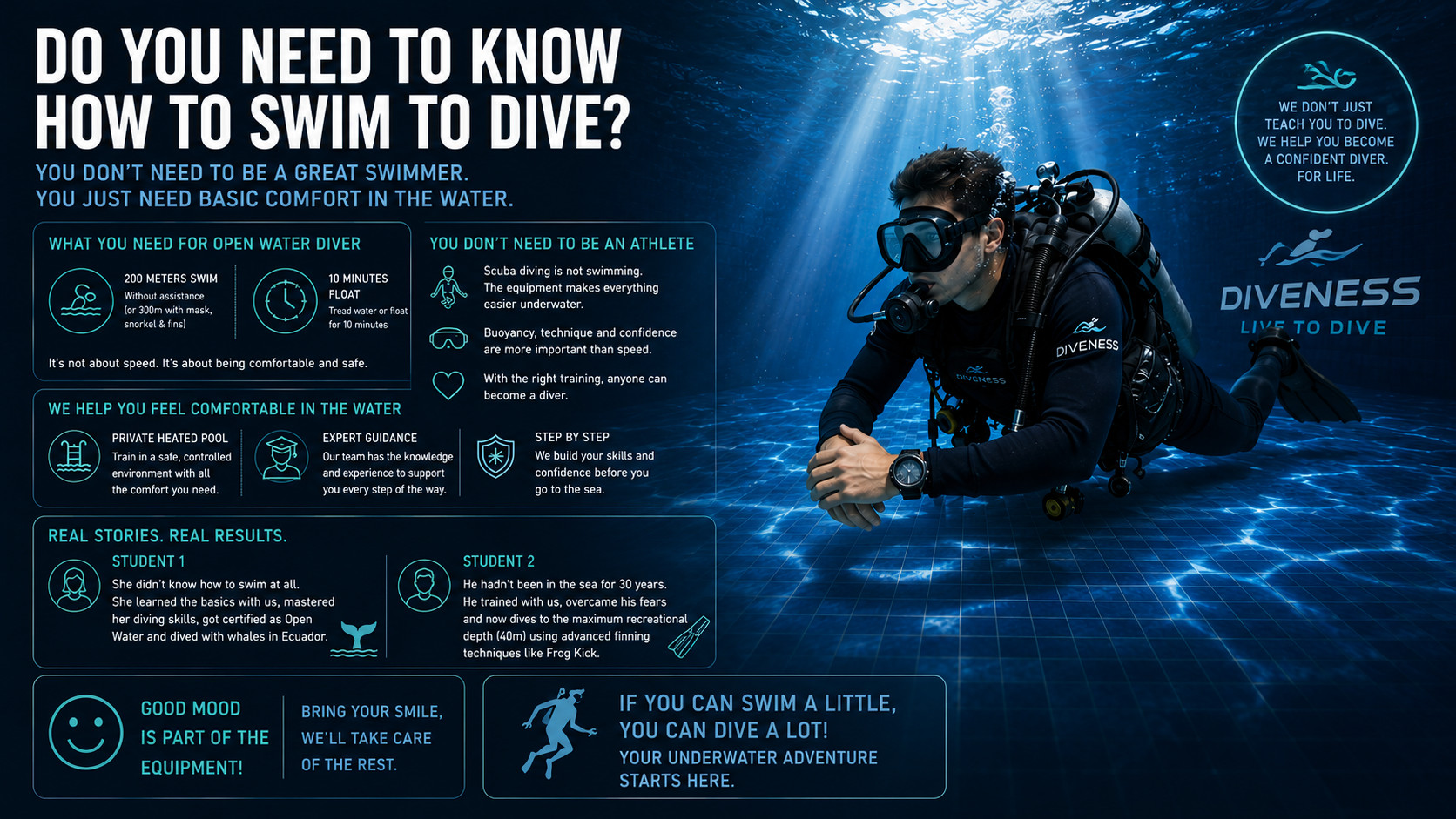
One of the greatest advantages we have at DIVENESS is our private training pool, designed specifically for diver education.
Before students ever enter the open sea, they have the opportunity to develop essential skills in a calm, controlled environment.
Here, they learn buoyancy control.
They practice mask clearing.
They remove and replace their equipment.
They solve simulated underwater problems.
Most importantly, they gain confidence.
This controlled environment allows students to repeat every skill until it becomes natural, reducing stress and making the transition to open water smooth and enjoyable.
Technical skills matter.
But building self-confidence is what truly transforms a beginner into a comfortable diver.
Every diver has personal limits.
These limits are not fixed.
They change depending on physical condition, sleep quality, stress levels, hydration, weather conditions, recent diving experience and many other factors.
A dive that feels easy today may not feel right tomorrow.
Recognizing this isn’t weakness.
It’s good judgment.
One of the most important skills any diver develops is learning to say:
“Not today.”
A good buddy will always respect that decision.
A professional dive team will support it without question.
Anyone who pressures another diver to exceed their personal comfort zone is not someone you should choose as a dive partner.
Safe diving is built on mutual respect.
The best dive is never the deepest one.
It’s the one where every diver feels comfortable, confident and fully in control.
Another interesting fact is that many of the diving accidents recorded worldwide do not involve beginner divers.
They involve divers with extensive experience.
How is this possible?
The answer often lies in overconfidence.
Over the years, some divers begin to skip equipment checks, spend less time planning their dives, or neglect scheduled equipment servicing, believing that their experience alone is enough to handle any situation.
In reality, the opposite is true.
Truly experienced divers are usually the ones who follow procedures with the greatest consistency.
They check their equipment before every dive.
They carefully plan every dive.
They respect their personal limits.
They never take anything for granted.
Experience does not replace procedures.
Experience makes procedures even more important.
Is scuba diving safe?
Yes.
As long as it is practiced with proper training, appropriate equipment, the right mindset, and respect for the rules that have been developed through decades of experience and scientific knowledge.
Diving is not a sport that rewards recklessness.
It rewards knowledge.
It rewards preparation.
It rewards teamwork.
And above all, it rewards respect — respect for the underwater environment, for your dive buddy, and for your own personal limits.
At DIVENESS, we believe that the goal of training is not simply for someone to obtain a certification.
It is to develop the mindset that will allow them to enjoy scuba diving safely for the rest of their life.
For us, safety is not just a rule we follow.
It is the culture upon which every dive is built.


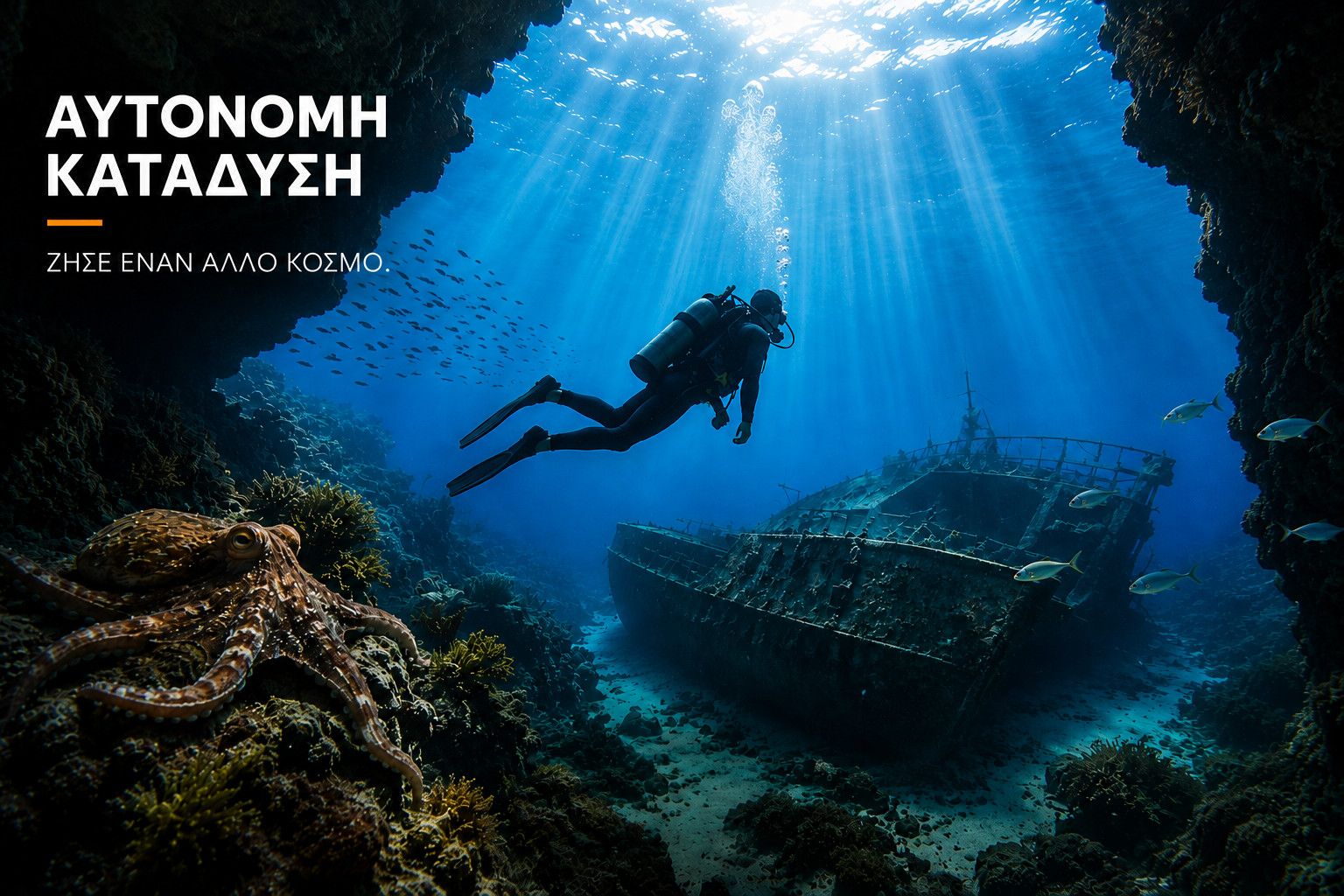


 Το Diveness επέλεξε το ΚΑΛΥΤΕΡΟ και ΜΕΓΑΛΥΤΕΡΟ ναυάγιο για τα Ελληνικά δεδομένα ,για να αποκτήσει ΑΚΟΜΗ μεγαλύτερη αξία αυτή η ιδιαίτερα συναρπαστική ειδικότητα της PADI, αλλά και ένα μεγάλο γνώστη και εξερευνητή πολλών ναυαγίων, που θα βρίσκεται μαζί μας καθόλη τη διάρκεια της διεκπεραίωσης της ειδικότητας και θα μας πλαισιώσει με τις επιπλέον γνώσεις του επι του αντικειμένου!
 Το EUROBULKER X & τον Αντώνη Γράφα!!
 Δεν περιλαμβάνει: nitrox και μετακίνηση στο Δήλεσι
 Συνολικός αριθμός επιτρεπόμενων μαθητών για τη διεκπεραίωση του αυτού μαθήματος —> 8 συμμετοχές! Αυτό σημαίνει ΕΛΑΧΙΣΤΕΣ θέσεις!!